GRADUATE TEACHING


According to records of the Department of Visual Art, there had been very little graduate activity in Printmaking for several years, leading up to my appointment in 2007. Fast forward to 2025, I am supervising two students in their MFA (one in first-year, and one in second-year). I have successfully supervised or co-supervised 12 MFAs to completion, prior, and I have served on the thesis committee for several others.
 
I believe that my re-invigoration of the Printmaking area at the University of Regina, as well as my profile, and approach have aided in the ability of the institution to recruit and retain graduate students. Graduate teaching is very different than undergraduate teaching, as any seasoned instructor will point out. I have learned a great deal through exposure to my colleagues in the Department of Visual Art, particularly (now Emeritus) Professor Leesa Streifler, whose mentorship in co-supervising my very first graduate student, was absolutely invaluable.

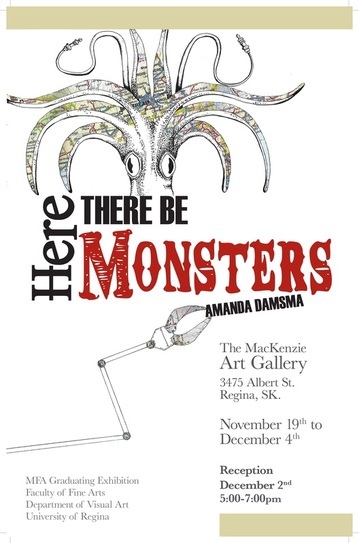
Amanda Damsa
Co-supervised with Professor Leesa Streifler
MFA Visual Arts programme entry 2009
Successfully defended 2011
External Examiner: Mark Bovey, NSCAD

Here, There Be Monsters
Here, There Be Monsters playfully illustrates the personal memories and realities of growing up between homes, as the child of divorced parents. The surreal drawings of suitcases — which appear to be part creature and part machine — are a metaphor for the mobile lifestyle that was a result of moving between the discreet households of my separated parents and two sets of grandparents.
While these are nonsensical renderings of luggage bags, by adding teeth, claws, wheels and gears they have the imagined potential to take on a life of their own. The life that I imagine for them is one that facilitates mobility. Humorously fulfilling my desire to adapt to a transient way of life the bags suggest that they can pack themselves and move on their own. The suitcases are childlike inventions that express naïve understandings of how things work as well as the anxieties and confusion that comes with living between places.
The routine of packing and unpacking is both a physical and mental endeavor. It is an act of mental preparation, an attempt at relocating oneself to a new location. The gears that appear throughout the exhibition are metaphors for the psychological switching of gears that is the result of transitioning from one place to another. The work considers the effect of relocation in respect to notions of the home and to what degree it is possible to feel at home in multiple places.
The work is created through screen printing and incorporates the specific colours and patterns from my remembered experiences. I use screen print as a way to celebrate the history of prints as visual communication and conveyers of information. There is a long-standing tradition of capturing and communicating tales of travel through printed material. Maps and books act as reminders of the places we have been, the places we will go to, and fantastical places we escape to in our mind.
The exhibition is a space to play, laugh and share. Please be warned that —like the mysterious beast and serpents created by early mapmakers— many creatures are waiting to be unpacked and discovered within the gallery... Here, There Be Monsters.
    -   Amanda Damsma, 2011
Rowan Pantel
MFA Visual Arts programme entry 2011
Successfully defended 2013
External Examiner: Joan Borsa

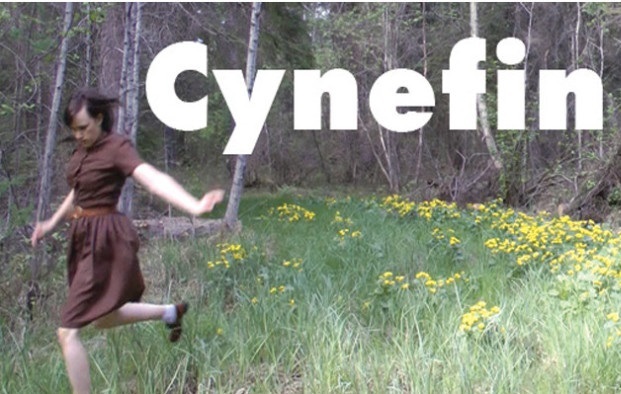
Cynefin
The exhibition explores themes of childhood memories, family folklore and the impossibility of repeating any single moment in time. I am exploring these ideas while utilizing images of the forest I grew up next to, and merging memories with dreams and fairytales. The forest represents the memories that are always persistent but are constantly changing and shifting under my feet, despite my best effort to record the ‘truth’.
There have been many threads that have come out of my research and investigation into memory and folklore. Gaston Bachelard’s Poetics of Space was a key resource, which led me to further explore the theatrical use of space within the gallery setting. The work crosses boundaries between reality and folklore, and explores our childhood perceptions and memories.      -   R. Pantel, 2013

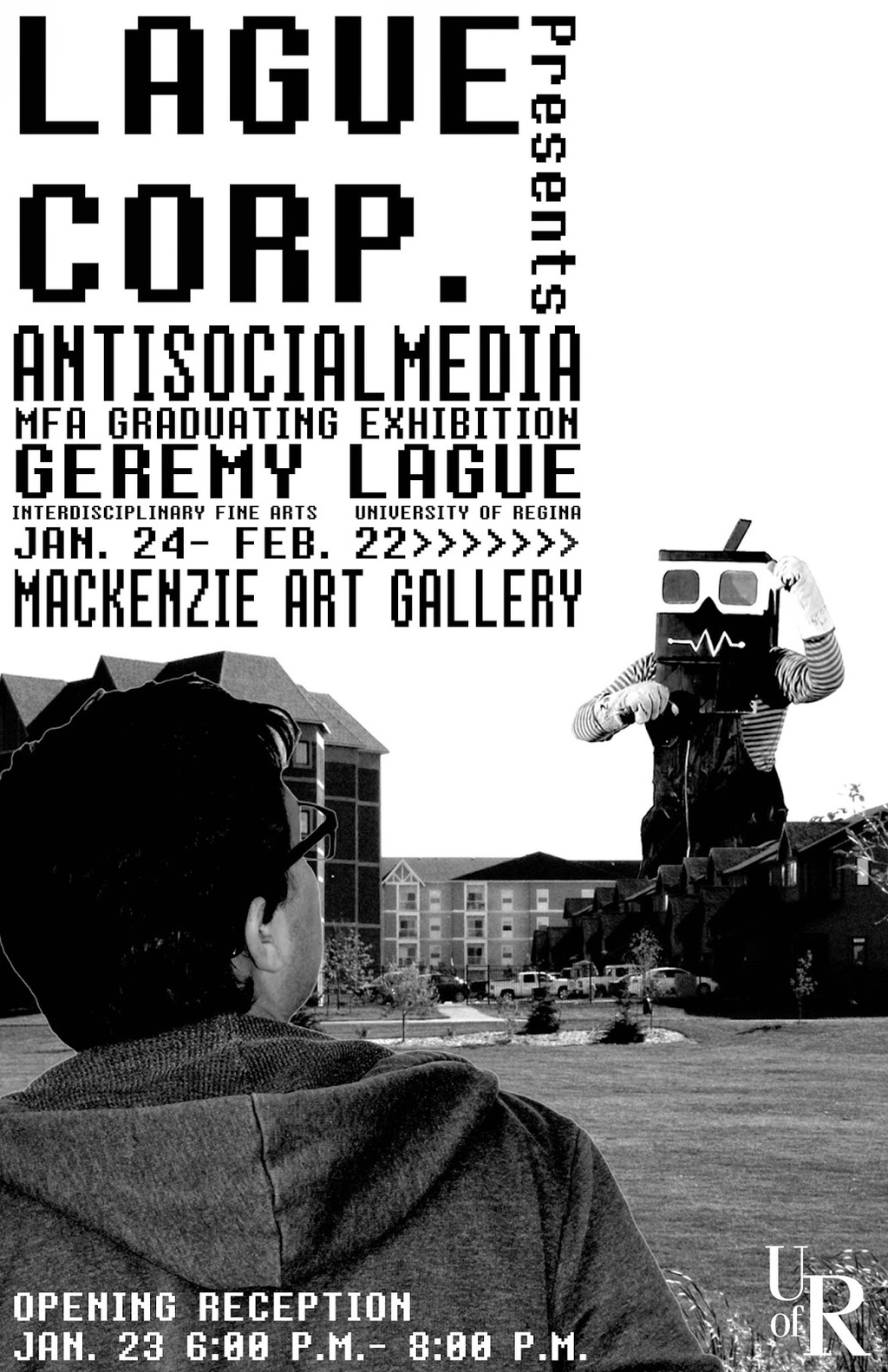
Geremy Lague
Co-supervised with Professor Gerald Saul
Interdisc MFA programme entry 2012
Successfully defended 2015
External Examiner: Lauren Nurse

Lague Corp. Presents Antisocial Media
Through my exhibition, I aim to offer a critique of current social media practice, by creating an alternative experience through a fictional corporation called LAGUE CORP. and the artwork created under its banner. The founder of LAGUE CORP., named Mr. Lague, is a caricaturized version of myself that enables me to form this critique. Through Mr. Lague I am able to simultaneously express the disconnect I perceive in the use of social media, and create something that re-establishes this connection.
The works presented in the exhibition cover a wide range of technical and conceptual practices. These include: performance, letterpress printing, lenticular imagery, photo printing, hand operated animation devices such as the mutoscope and flipbook, traditional dark room processes in the formation of View-Master imagery, sound, 16mm film, and stereoscopic 3D techniques.
The conceptual basis for the exhibition lies in my understanding of how social media operates within society through the theories of Allan Sekula, Louis Althusser, and Michel Foucault. This is juxtaposed with the methodology of media archeology and the theories of Siegfried Zielinski, Jussi Parikka, Erkki Huhtamo, and Wolfgang Ernst.
   -  G. Lague, 2014

Lacia Vogel
MFA Visual Arts programme entry 2013
Successfully defended 2015
External Examiner: April Dean, Society of Northen Alberta Printmakers and U of A

Repeat
The Exhibition Repeat is an aesthetically spare installation consisting of carefully and precisely fashioned prints and predominantly blank sculptural paper forms. Through the artworks presented in the R.H.W. Foundation Gallery at the MacKenzie Art Gallery, I am trying to visualize how matter coalesced into individual forms at the beginning of time, and how human life evolved from that primordial space and time. A number of the pieces are books, or book-like objects. Ironically through a lack of text, the blankness in these sculptures implicitly poses a number of questions about words, such as: Where did language come from? How did we learn to communicate? What is our relationship to language? The prints that line the gallery walls use circles to symbolize the first stars and planets that appear in this imagined universe.
This exhibition embodies the results of my research into the value of manual and meditative artistic methods. The use of unembellished paper as both medium and subject symbolizes, at the least, my desire to elevate the supporting material to the same level as the subject matter typically imposed upon it. This supporting document gives a comprehensive account of the artistic work leading up to the exhibition Repeat and explains the conceptual and theoretical underpinnings of the show.
By cutting and folding large amounts of paper by hand for many hours on end, I have developed a deeper understanding of what motivates me as an artist. Particular methods generate a sense of equilibrium in a world whose pace sometimes threatens to overwhelm my senses. My practice has been enriched by reflections on the literal idea of nothing, philosophical concepts of Nothingness and repetition, and the earnest but unattainable human desire to achieve perfection. My personal quest for exactitude resulted in an exhibition in which the forms demonstrate a high regard for meticulous and attentive effort.
   -  L.Vogel, 2015

Kallie Garcia
Co-supervised with Professor Sean Whalley
MFA Visual Arts programme entry 2015
Successfully defended 2017
External Examiner: Kim Hyuhn, U of C

Altogether but Unsettling
The Exhibition is a comprehensive view of my studio practice and includes two dimensional multimedia paintings, drawings, Silkscreen prints and photographs, as well as film projections and sculptures all inspired by personal struggles that confess secrets of vulnerability.

The exhibition explores memories and experiences using child’s play motifs, the notion of home, hair, nests and fort like structures to create personal narratives. Within these narratives I invite the viewer to relate to and
witness the value of confiding in one another and allowing for personal vulnerability.
Many of my thoughts have developed from journaling while investigating personal memories and vulnerabilities. Brene Brown’s Daring Greatly, How the Courage to Be Vulnerable Transforms the Way We Live, Love, Parent and Lead was an inspiring resource which led me to further explore confessing personal vulnerabilities through art making, creating a space within the gallery to allow the viewer to bear witness.
   -  K. Garcia, 2017

Jessica Richter (Elke Richter)
MFA Visual Arts programme entry 2014
Successfully defended 2017
External Examiner: Heather Huston, AUofA

Hausmärchen
This exhibition and paper explores the complex relationship I had with my grandma, Adelheid Richter, through the context of her experiences as a German citizen during World War II and her experiences as an immigrant to Canada following the war.  The exhibition contains four multimedia, sculptural pieces, evoking the landscape and houses of my grandparent’s farm and the Black Forest Weather Houses that they kept on their knick-knack shelves. 
This support paper discusses the history as well as family lore that has contributed to the work. I give a description of the exhibition, and then delve into the military and social history of World War II Germany, to provide context for my grandma’s early experiences both pre, and post, emmigration.  First, I discuss the political and social climate of East Prussia at the close of the war; where my grandma was situated as a female civilian.  Following this, I explore and explain the culture and challenges experienced by German immigrants to Canada in the aftermath of the war, contextualizing my grandma’s assimilation to Canada and the consequences this had on subsequent generations.  Once I have established the historical and social context, I discuss how the trauma of war contributed to the fractured relationships within my family, and the notion of “decay” as a means to express that.  The use of the miniature is discussed, leading into the aesthetic inspirations of the work.  I discuss my work in the context of female folk art, contrasting the tradition of papercutting and my laser cutting.  Additionally, I delve into the role of Twee culture, feminine aesthetics, and Grimm’s Fairy Tales as both aesthetic and conceptual inspirations.  Finally, I conclude with a discussion of artists Amalie Atkins and Heather Benning, and their influence on the process of the work. 
   -  J. Richter, 2017

Brian Hoad
MFA Visual Arts programme entry 2015
Successfully defended 2017
External Examiner: Sean Caulfield, U of A

Handrails
The exhibition is a reflection surrounding the artist, myself, attending and working at a summer camp from 2001-2013.


Handrails are recognizable symbols included on maps to assist in navigation. These include fences, roads, key buildings, etc. At Quin-Mo-Lac a glacial erratic served as the most notable one of these on the ecological hiking trail. Glacial erratics are rocks that were formed elsewhere and are now set in areas not native to them. Despite appearing as a permanent fixture within the landscape, they have physical properties to indicate their foreign origins. In this exhibition, the metaphor of handrail and glacial erratic have been explored in a manner connecting experiences with camp and wilderness to a critical evaluation of how wilderness institutions carry out ideological agendas.
The first section of this paper will outline my interest in aligning Michel Foucault’s conceptual heterotopia with the North American summer camp (specifically Camp Quin-Mo- Lac) while also identifying the ways in which my experiences attending and working at camp situate themselves with my coming-of-age experience, ultimately arriving at an affective, sentimental experience within nature. This is in alignment with the philosophy that Simone Weil directs towards nationhood, specifically, her text The Need For Roots; Prelude to a Declaration of Duties Towards Mankind. Following these theoretic discussions, artistic influences will be acknowledged as I situate my own work alongside theirs. The practice-based research methodologies used and creative processes will then be reviewed, prior to describing the exhibition in detail.
   -  B. Hoad, 2017

Tye Dandridge-Evancio
MFA Visual Arts programme entry 2017
Sucessfully defended 2020
External Examiner: Marcus Miller

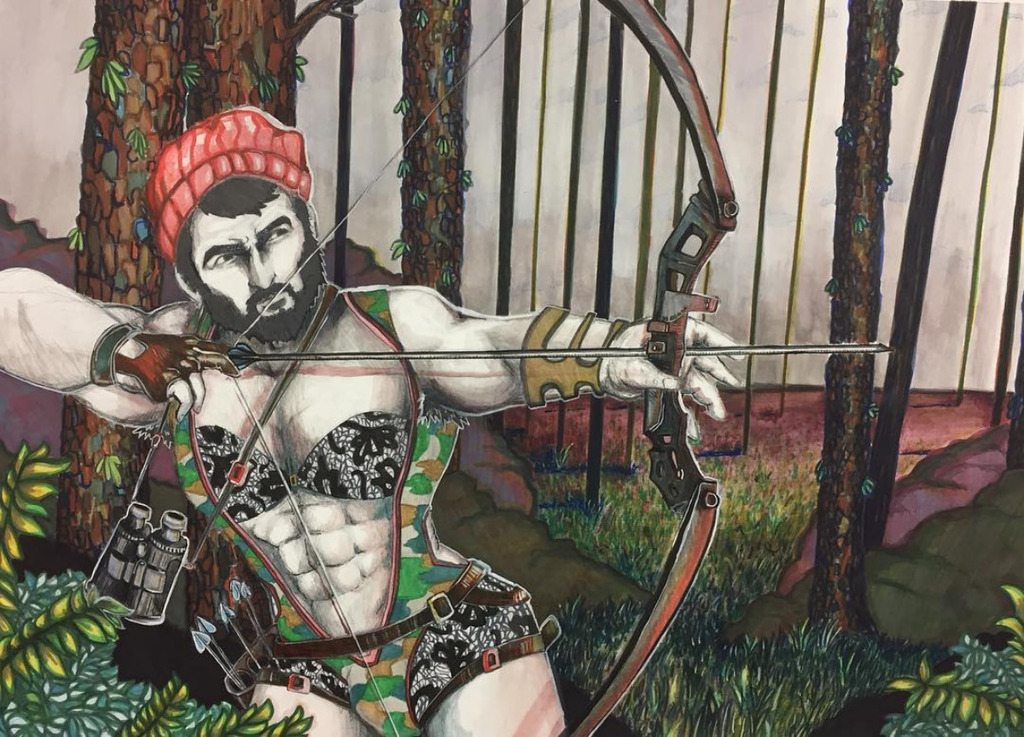
Cabela Boys

Growing up, I was fascinated by the engaging storylines and dynamic imagery of videogames and animated series from the late 90’s. There were, however, few characters with whom I felt could relate. Later, I would discover this was due to my identity as a queer man and the exclusion of any and all queer characters from media aimed at younger audiences. Of course, there was the possibility to turn my attention to other genres and television programming, but the idea of watching Sarah Jessica Parker regale stereotypical gay, male friends with stories of her sexual exploits in New York City did not appeal to me. I did not want to see angst-filled boys, played by straight actors, living out a bleak and traumatic experience of being abused and bullied by their parents and peers on a melodramatic afterschool special. I wanted the protagonists of the actionpacked adventure series about superheroes or a squad of sassy teenagers tasked with saving the world to allow queer and non-binary characters to join their ranks. It didn’t seem like such an outlandish request, yet even today many remain resistant to the inclusion of LGBTQ characters in the world of videogames and cartoons. I am well acquainted with the absurd argument that an excessive number of queer characters would feel forced and unnatural, or worse, risk converting previously straight viewers into lascivious homosexuals. After 27 years of being exposed to media, in which the majority of characters are cis-gendered heterosexuals I have yet be any less attracted to the same sex. Nothing felt more unnatural to me than watching fictional worlds inhabited by only one representative of each demographic that fell outside the norms of western popular culture. Without my knowledge or active participation, the exclusion of queer representation from mainstream media instilled a deep sense of shame in me.
 -Tye Dandridge-Evancio, 2020

Madeleine Greenway
MFA Visual Arts programme entry 2018
Successfully defended Summer 2021
External Examiner: Lauren Fournier

Propogation

My earliest memories are of the garden. My mother and neighbour Betty toiled happily in their adjacent yards in the afternoon while my sisters were at school. The summers are short here in Regina, and yet what I remember most are the days spent in the garden. What captured my attention then still fascinates me. The intense focus on detail that I’ve had since I was a child is replicated in my art. The food and family that populate my prints and drawings are removed from their context and preserved. To represent these objects and subjects with intense care provides me in the making, and the viewer in the viewing, the opportunity to examine what we often take for granted. These works need to be received and given a new life. I want to invite the onlooker to experience a childlike approach to the garden and kitchen—to feel wonder and admiration in the ordinary. My work stimulates that hunger to return—to care for those spaces, to nurture our communities through them, and in turn to allow ourselves to be taken care of by them.
 - Madeleine Greenway, 2021

Alyssa Scott
MFA Visual Arts programme entry 2020
Successfully defended Fall 2022
External Examiner: Jonathan S. Green

Shadowy Precipices and Light-Veiled Summers

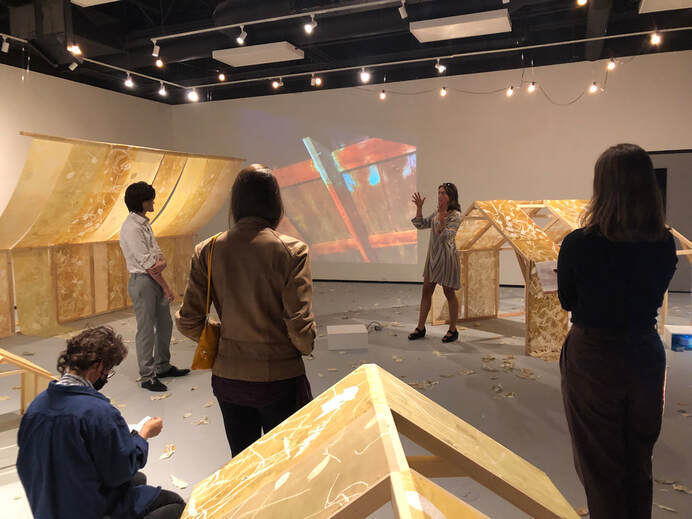
My graduating exhibition is a printmaking sculpture and video projection installation that evokes images of home exploring the space between my family farm and the contradictions inherent to living on the land, cultivating the land and transforming nature in order to do so. The gallery is filled with idyllic, illuminated, and simplified representations and silhouettes of the barn, land, and plants, which suggest a utopic construction of nature and rural structures, yet these are illusions that hang on the thread of memory and are on the verge of disintegrating.
This exhibition and supporting paper explore the permeable boundaries of rural structures to consider how both forces of nature and the impact of our transformations of nature act on each other, intertwine and co-exist, in both constructive and renewing, and deconstructive and decaying ways. Through this my work reflects on our role in processes of earth regeneration while also pointing to the current unsustainable, destructive, and fragile ways we transform nature. This exhibition and paper consider that while the structures that we inhabit and that shelter us are necessary for survival, they are a smaller echo of the earth: a delicate boundary that is also necessary for shelter and survival.
  - Alyssa Scott, 2022


Nicole Banton
MFA Visual Arts programme entry Fall 2022
Successfully defended Fall 2024
External Examiner: Heather Leier, U of C

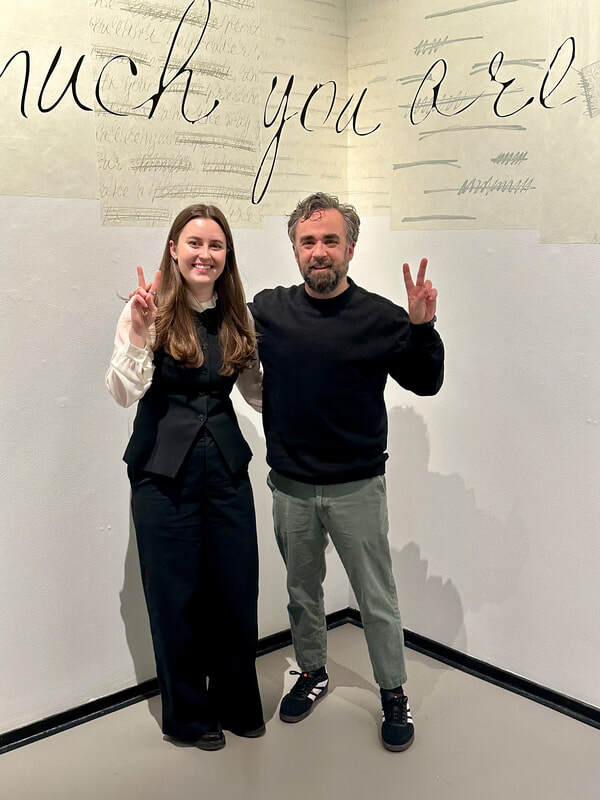
Manufactured Memory

The memory of the notes my mom wrote to me throughout my childhood provides the framework through which this exhibition explores themes of loneliness, longing, authenticity, and failure. By using the AI chatbot ChatGPT to recreate this memory, I assess the abilities of conversational AI to mimic human connection and consider how it can function as a mirror that can offer insight into what it means to be human. The AI-generated text presented throughout the exhibition creates a tension between authenticity and artificiality that encourages the audience to consider how meaning and sentiment are extracted from language. I use printmaking to make visible the abundance of interactions between myself and ChatGPT, and express the frustration experienced through the physicality of the autographic strikethroughs.
This exhibition investigates how the ways we choose to interact with AI can reveal sides of ourselves and our desires that we may not see otherwise. It uses failure as a strategy for navigating feelings of longing and loneliness and examines relationships through the documentation of the process of attempting to recreate a sentimental childhood memory using ChatGPT.
 - Nicole Banton, 2024

Rozhin Tayarani
Co-supervised with Professor Holly Fay
MFA Visual Arts programme entry Fall 2022
Successfully defended Fall 2024
External Examiner: Anna Binta Diallo, U of M

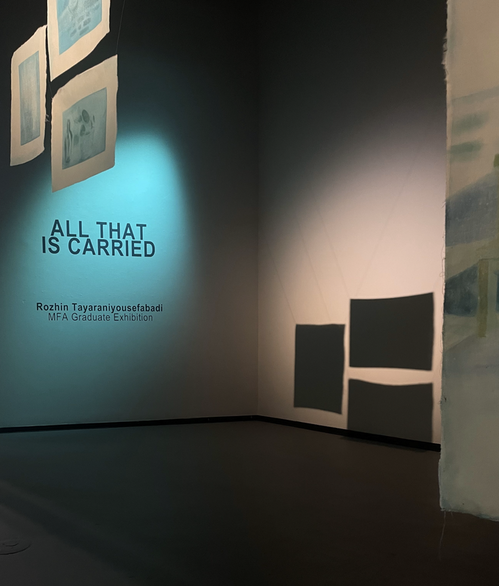
All That is Carried

All That Is Carried concerns ideas of home, longing, displacement, and memory. My intention is to convey feelings of disorientation and in-betweenness caused by leaving my family home, and home country. This exhibition addresses the complexity of my transitional state between homes. The installation consists of unstretched, shaped, and cut fabrics painted with images of  interiors of my former home in Iran. The paintings draw from photographs I took of my former  home. A wooden suitcase filled with folded paintings accompanies the hung paintings.
Migration is the most significant change of my life. Visiting my family home in Iran, while living in Rome, was like stepping back in time, but into a timeline that I no longer belonged to. I was a visitor in my parent’s house. Everything that remained behind: my family, friends, most significantly, my feelings of home, was altered. What once felt whole and meaningful was now distant. Yet, the existence of my parent’s house kept these feelings of home prevalent in my life. Despite living in Rome, I carried the unsettling feeling of being tied to a home while also separate from it. This state of suspension had me question what home and belonging mean, especially now that my parents, too, have left that house. This double loss felt like the centre of my world had disappeared, leaving me adrift. All That Is Carried remembers and reimagines that house through painting—transforming it into a tangible memory. The paintings are on a lightweight fabric, like clothes, something I can pack and carry with me. Through the process of making, I am now at a better understanding of what my former home provided for me. I can preserve and carry the significance of home with me.
 - Rozhin Tayarani, 2022

Elise Masotti
 MFA Visual Arts programme entry Fall 2024

Karys Hallett
MFA Visual Arts programme entry Fall 2025